
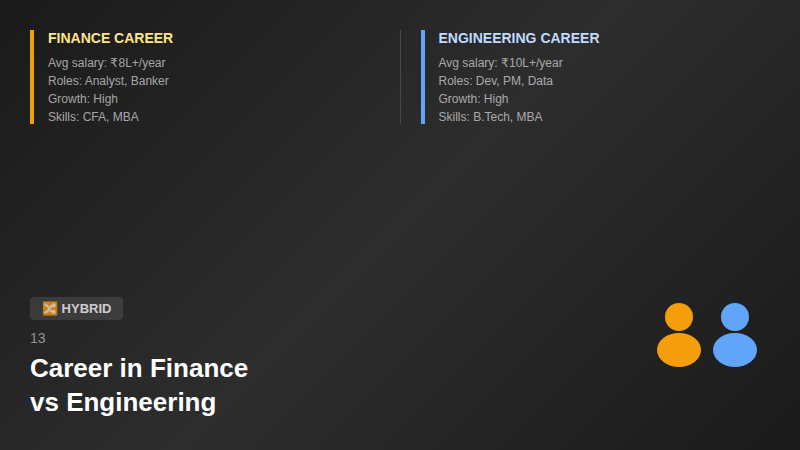
Two of the most popular and respected career paths for university students globally are finance and engineering. Both offer strong salaries, intellectual challenge, and long-term career prospects. But they are fundamentally different in terms of what you study, what you do day-to-day, how you progress, and ultimately, what kind of financial and professional life they lead to.
If you are deciding between these two paths — or wondering whether you made the right choice — this article gives you an honest, data-informed comparison across salary, career growth, job stability, future scope, and lifestyle.
A Quick Overview of Each Path
Finance careers include roles in investment banking, corporate finance, asset management, financial planning and analysis, private equity, venture capital, financial consulting, fintech, and insurance. Finance professionals work with money — analyzing it, allocating it, managing risk, and helping businesses and individuals make better financial decisions.
Engineering careers cover a wide spectrum — mechanical, civil, electrical, chemical, computer, aerospace, software, and more. Engineers design, build, and maintain systems, structures, technology, and infrastructure. The day-to-day work is highly technical and often tied to specific industries.
Both paths start with a university degree, but the skills, environments, and trajectories are quite different.
Salary Comparison
Salary comparisons between finance and engineering are nuanced because both fields have a wide range depending on specialization, location, company, and experience level.
Entry-Level Salaries
Finance: Entry-level positions vary widely. A graduate analyst at a large investment bank typically earns a significantly higher base salary than most other entry-level positions, with performance bonuses that can be substantial. However, investment banking is a small slice of the finance world. Financial analysts, planners, and insurance professionals at entry level typically earn moderate salaries that grow steadily with experience.
Engineering: Entry-level engineering salaries are generally strong and competitive, particularly in software engineering, petroleum engineering, and specialized fields. Software engineers at major technology companies often earn very high starting salaries, frequently matching or exceeding those in finance.
Mid-Career and Senior Salaries
Finance: The upside in high-finance careers (investment banking, private equity, hedge funds) is among the highest in any profession. Managing directors, portfolio managers, and senior partners can earn very high total compensation. However, reaching these levels requires years of extremely demanding work and significant performance.
Engineering: Senior engineers and engineering managers at major technology companies earn very competitive salaries. In software engineering particularly, senior and staff-level engineers at top companies earn exceptionally well. Civil and mechanical engineers at senior levels earn well but generally less than their software engineering counterparts.
Stability vs Upside
Finance careers — particularly in investment banking and asset management — tend to be more variable. Bonuses can be enormous in good years and much smaller in downturns. The income ceiling in high finance is very high, but so is the volatility.
Engineering careers — particularly in technology — tend to offer more stable, predictable compensation growth. The ceiling may be lower than the very top of finance, but the floor is higher and the path is more consistent.
Career Growth and Progression
Finance Career Path
A typical finance career trajectory:
- Analyst (2–3 years)
- Associate (2–3 years)
- Vice President / Manager (3–5 years)
- Director / Senior Manager
- Managing Director / Partner / CFO
In investment banking, the up-or-out culture means you either advance quickly or you leave. In corporate finance, the progression is more stable. Professional qualifications (CFA, CPA, MBA) significantly accelerate advancement.
Engineering Career Path
A typical engineering career trajectory:
- Graduate / Junior Engineer
- Engineer
- Senior Engineer
- Principal / Lead Engineer
- Engineering Manager (if moving into management) or Staff / Distinguished Engineer (technical track)
Many engineers face a fork in the road mid-career: continue on a technical track (becoming a deep technical expert) or transition into management (leading teams and projects). Both paths are valid and well-compensated in technology.
Future Scope: Which Field Has Better Long-Term Prospects?
Finance: Future Outlook
Finance is evolving rapidly due to:
- Technology and automation — routine financial analysis tasks are increasingly automated by software and AI, reducing demand for certain entry-level roles
- Fintech disruption — technology companies are entering financial services, creating new types of finance roles at the intersection of technology and finance
- Growing global wealth — more people in more countries are investing, creating demand for wealth management and financial advisory services
- Data-driven finance — demand for finance professionals with strong quantitative and data skills is growing significantly
Finance professionals who combine traditional finance knowledge with technology skills are among the most sought-after in the market right now.
Engineering: Future Outlook
Engineering — particularly software and technology engineering — has one of the strongest long-term outlooks of any profession:
- AI and automation create enormous demand for the engineers who build and maintain these systems
- Climate technology and renewable energy are creating massive new engineering sectors
- Infrastructure investment globally drives demand for civil and mechanical engineers
- Healthcare technology expansion drives demand for biomedical and software engineers
Software engineering in particular shows no signs of reduced demand despite AI advances — if anything, AI tools increase the productivity of skilled engineers and raise demand for those who can build AI-powered systems.
Work-Life Balance
This is where the two paths diverge most significantly at certain levels.
Investment banking and high finance is notorious for extremely long hours, particularly in the early years. 70–100 hour weeks are common for analysts and associates at top banks. The compensation is high partly because the lifestyle demands are enormous.
Corporate finance and financial planning offers much more reasonable hours — typically 45–55 hours per week, with more predictable schedules.
Engineering varies enormously. Software engineers at large technology companies generally report better work-life balance than finance peers at similar levels. However, engineers at startups or in project-deadline-intensive roles can also face significant hours.
Which Should You Choose?
There is no objectively superior choice between finance and engineering. The right path depends on:
- Your interests — Are you more drawn to financial markets, business, and economic analysis? Or to building systems, solving technical problems, and creating technology?
- Your strengths — Do you excel in communication, analytical thinking, and business acumen? Or in mathematics, systems thinking, and technical problem-solving?
- Your lifestyle priorities — Can you handle the demanding hours of high finance, or do you prefer a more stable work-life balance?
- Your income goals — Both paths can lead to very high incomes, but through different routes and timelines.
Consider finance if: You are fascinated by markets and capital allocation, comfortable with performance-driven culture, motivated by business and deal-making, and willing to work demanding hours early in your career for high financial upside.
Consider engineering if: You enjoy building things and solving technical problems, prefer project-based work with clear deliverables, want strong job security with good compensation, and value a more stable and predictable career path.
The Emerging Middle Ground: Fintech and Quantitative Finance
For students drawn to both worlds, the intersection of finance and technology offers some of the most exciting and well-compensated opportunities available. Roles in fintech product management, quantitative analysis, algorithmic trading, and data science for financial services combine the best of both fields.
Students who develop strong skills in both finance fundamentals and technology — particularly data analysis, programming, and systems thinking — are exceptionally well-positioned for the careers of the future.
Final Thoughts
Finance and engineering are both excellent career choices with strong future prospects, good earning potential, and intellectually stimulating work. The best choice is the one that aligns with your genuine interests, strengths, and values.
Explore both fields through internships, industry events, and conversations with professionals before committing. And remember — the skills and knowledge you build in either field can serve you in building your own wealth throughout your career, regardless of which path you choose.