
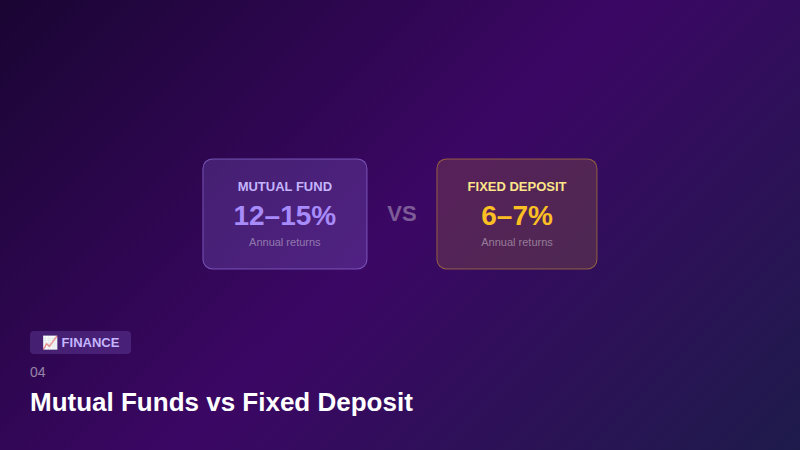
When it comes to saving and growing your money, two of the most popular options for everyday investors are mutual funds and fixed deposits. Both have been trusted by millions of people for decades, but they work in very different ways and suit very different types of investors and goals.
If you have ever wondered which one is better for your money in 2026, this article breaks down everything you need to know — returns, risk, liquidity, taxes, and which option suits which type of person.
What Is a Fixed Deposit?
A fixed deposit (FD) is one of the simplest financial products available. You deposit a lump sum of money with a bank for a fixed period — anywhere from a few months to several years — and the bank pays you a guaranteed interest rate on that amount.
At the end of the tenure, you get back your original amount plus the interest earned.
Key features of fixed deposits:
- Guaranteed returns — you know exactly how much you will earn
- No market risk — your principal is safe
- Available for short to long tenures
- Interest rates are fixed at the time of deposit
- Premature withdrawal is usually possible but may attract a penalty
Fixed deposits are simple, safe, and predictable. They are ideal for people who cannot afford to risk their principal or who need certainty about future returns.
What Is a Mutual Fund?
A mutual fund pools money from many investors and invests it in a diversified portfolio of assets — stocks, bonds, or a combination of both — managed by professional fund managers.
The returns from a mutual fund are not guaranteed. They depend on how the underlying assets perform in the market. In good years, mutual funds can deliver strong returns. In bad years, they can deliver lower returns or even temporary losses.
Key features of mutual funds:
- Returns are market-linked — higher potential, but with risk
- Professionally managed
- Highly diversified — spreading risk across many assets
- Various types available — equity funds, debt funds, hybrid funds
- Can be started with very small monthly amounts via SIP
Returns Comparison: Mutual Funds vs Fixed Deposit
This is usually the first question people ask — which one makes more money?
Fixed deposit returns (typical range):
- Short-term (1–2 years): 5% to 7% per annum
- Long-term (3–5 years): 6% to 7.5% per annum
- Senior citizen FDs often offer slightly higher rates
Equity mutual fund returns (historical average):
- Short-term (1–3 years): highly variable, can be negative in bad years
- Long-term (5–10+ years): historically 10% to 14% per annum on average
- Debt mutual funds: typically 6% to 8%, more stable than equity funds
The key takeaway here is this: over the long term, equity mutual funds have historically outperformed fixed deposits by a significant margin. However, this comes with short-term volatility and no guarantee.
Over a 10-year period, the difference in returns can result in a dramatically larger final corpus from mutual funds compared to an FD — sometimes two to three times more.
Risk Comparison
Fixed deposits carry virtually zero risk to your principal. The only risk is inflation — if inflation is higher than your FD interest rate, your money is actually losing purchasing power in real terms.
Mutual funds carry market risk. The value of your investment can go down in the short term. Equity funds carry the most risk, while debt funds carry much less. However, over long periods, market risk tends to diminish as markets generally trend upward.
The golden rule: the longer your investment horizon, the more suitable mutual funds become.
Liquidity: Which One Lets You Access Money Faster?
Fixed deposits — You can break an FD before maturity, but there is usually a penalty (typically 0.5% to 1% reduction in interest). This makes FDs slightly inflexible.
Mutual funds — Most open-ended mutual funds allow you to redeem your money at any time, usually within 1–3 business days with no penalty (except for ELSS tax-saving funds which have a 3-year lock-in). This makes mutual funds generally more liquid than FDs.
Tax Comparison
Tax treatment varies by country and fund type, but broadly:
- Fixed deposit interest is typically taxed as regular income, which can result in a significant tax burden for high earners
- Equity mutual fund gains held for over one year are often taxed at a lower long-term capital gains rate
- Debt mutual fund gains are usually taxed based on your income slab
For investors in higher tax brackets, the tax efficiency of mutual funds can make a meaningful difference to net returns.
Which One Should You Choose?
| Factor | Fixed Deposit | Mutual Fund |
|---|---|---|
| Returns | Moderate, guaranteed | Higher potential, variable |
| Risk | Very low | Low to high (depends on type) |
| Liquidity | Moderate | High |
| Investment horizon | Short to medium | Best for medium to long term |
| Best for | Safety, short-term goals | Wealth building, long-term goals |
Choose fixed deposits if:
- You need the money in less than 2 years
- You cannot afford to risk any part of your principal
- You are building an emergency fund
- You are a retiree or conservative investor
Choose mutual funds if:
- You are investing for 5+ years
- You can tolerate short-term ups and downs
- You want to build long-term wealth
- You want to start with small monthly amounts
The Smart Approach: Use Both
You do not have to choose one over the other. A balanced financial plan uses both:
- Keep your emergency fund in a fixed deposit or high-interest savings account
- Invest your long-term wealth-building money in diversified mutual funds via SIP
- Use debt mutual funds as a middle ground for medium-term goals
This combination gives you safety, liquidity, and growth potential all at once.
Final Thoughts
Both mutual funds and fixed deposits have an important place in personal finance. Fixed deposits offer peace of mind and guaranteed returns. Mutual funds offer the potential for significantly higher long-term growth.
The right choice depends on your goals, timeline, and risk tolerance. And for most people building wealth over the long term, the answer is not one or the other — it is a smart combination of both.